Choke Valves: Purpose, Types, and Role in Oil & Gas Production
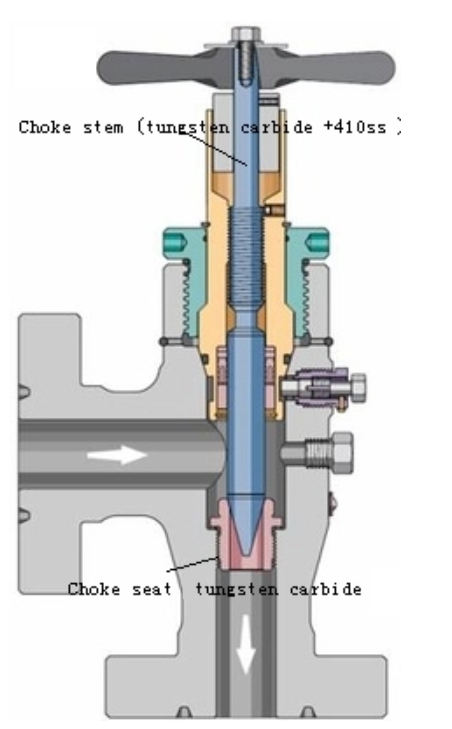
A choke valve is a critical type of control valve used primarily in oil and gas production. Its core functions are to control the flow of well fluids, kill (reduce) reservoir pressure, and regulate downstream pressure in flowlines. By forcing fluid through a small, precisely sized opening, it effectively reduces high upstream pressure while managing the production rate from the well. Given that reservoir fluids often contain abrasive sand particles, these valves are specifically engineered to withstand erosive service conditions.
A typical well setup features two choke valves installed in series for optimal control and safety.
Non-Regulating Choke Valves
The non-regulating choke valve acts primarily as an on-off valve. Its key function is to kill the high reservoir pressure, reducing it to a safer, desired operating pressure for the flowline. The opening (orifice) in this valve is sized to achieve this pressure drop when the valve is fully open. It is not used for fine flow control.
Over the lifetime of a well, reservoir pressure naturally declines as oil and gas are extracted. To maintain consistent production levels, the non-regulating choke valve may need to be replaced with units that have progressively larger openings, allowing more flow for the same pressure differential.
Regulating Choke Valves
Located downstream of the non-regulating valve, the regulating choke valve is responsible for maintaining a steady and precise production rate. It is an automatic control valve that adjusts its opening based on electric or pneumatic signals from a central control panel. This continuous adjustment allows it to fine-tune the flow and stabilize pressure in the downstream flowlines and production header, ensuring efficient and controlled well output.