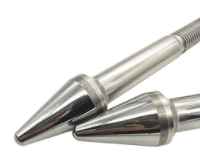
Cemented carbide is a powder metallurgy material with metallic properties, which is made of metal carbide (such as WC, TiC, TaC, etc.) as a matrix and an appropriate amount of metal powder (such as Co, Ni, Mo, etc.) as a binder.
Performance characteristics
- High hardness: The hardness can reach 86-93HRA (equivalent to 69-81HRC) at room temperature.
- Good wear resistance: With high hardness and high wear resistance carbide as the skeleton, it can maintain stable performance for a long time under friction environment.
- High compressive strength: The compressive strength can reach 6000MPa.
- Good corrosion resistance and oxidation resistance: It can resist corrosion and oxidation in some harsh working environments.
- Poor toughness: low bending strength, high brittleness, and poor thermal conductivity.
Classification
- Tungsten-cobalt type: The main components are tungsten carbide (WC) and cobalt, with high bending and compressive strength, impact toughness and elastic modulus.
- Tungsten-cobalt-titanium: The main components are tungsten carbide (WC), titanium carbide (TiC) and cobalt, with good oxidation resistance and red hardness.
- General alloy: The main components are tungsten carbide (WC), titanium carbide (TiC), tantalum carbide (TaC) or niobium carbide (NbC) and cobalt, with good comprehensive performance.
- New steel-bonded cemented carbide: cemented carbide with steel as a binder.
Production process
Mainly includes three stages: powder preparation, pressing and high-temperature sintering.
Application areas
- Cutting processing: manufacturing turning tools, milling cutters, drill bits and other tools for cutting various metal and non-metal materials.
- Mold manufacturing: used to manufacture injection molds, die-casting molds, etc., to improve mold durability and precision.
- Mining and drilling: manufacturing rock drilling tools, mining tools, drilling tools, etc., such as oil drill bits.
- Other fields: manufacturing measuring tools, wear-resistant parts, metal abrasives, cylinder liners, precision bearings, nozzles, etc.